

In modern railway systems, safety, stability, and durability rely on thousands of precision-engineered components working together seamlessly. Among them, train track nails may appear simple, yet they play a fundamental role in securing rails and sleepers under extreme mechanical stress and environmental exposure.
From heavy freight corridors to urban rail transit systems, the performance of track fasteners directly impacts track geometry, vibration control, and long-term maintenance costs. Manufacturers such as HuiBo Railway focus on producing train track nails that meet stringent international standards while delivering consistent performance in real-world rail operations.
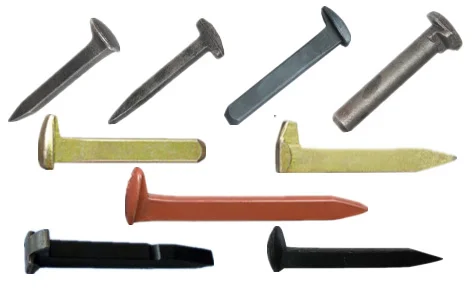
What Are Train Track Nails
Train track nails are specialized fastening elements used to fix rails or base plates to wooden or composite sleepers. Unlike general-purpose fasteners, these nails are engineered to withstand:
Continuous dynamic loads from passing trains
Lateral forces caused by braking and acceleration
Environmental stress such as moisture, temperature changes, and corrosion
Their design ensures secure rail positioning while allowing controlled elasticity to accommodate rail movement.
Structural Role in Railway Track Systems
Rail Fixation and Stability
Train track nails maintain precise rail alignment by anchoring rails firmly to sleepers. This prevents rail shifting, gauge widening, and uneven load distribution.
Vibration and Impact Resistance
Each passing train generates vertical and horizontal forces. Properly designed track nails absorb micro-movements, reducing vibration transfer and extending sleeper life.
Long-Term Track Geometry Control
Consistent nail holding strength helps preserve track geometry over time, minimizing maintenance interventions and improving ride comfort.
Materials and Manufacturing Technologies
Material Selection
High-quality train track nails are typically manufactured from:
Medium to high carbon steel
Alloy steel with enhanced tensile strength
These materials provide a balance between hardness, ductility, and fatigue resistance.
Heat Treatment and Surface Protection
Advanced manufacturing processes include:
Controlled heat treatment to optimize mechanical properties
Anti-corrosion coatings such as galvanization or phosphate treatment
HuiBo Railway applies strict metallurgical controls to ensure each nail delivers uniform performance across large-scale railway projects.
Types of Train Track Nails
Different railway environments require different nail designs:
Square shank nails – High holding power for wooden sleepers
Cut spikes – Traditional design with strong lateral resistance
Screw spikes – Enhanced pull-out resistance and reusability
Special profile nails – Custom solutions for specific rail systems
Each type is selected based on sleeper material, rail load, and operational conditions.
Performance Standards and Quality Requirements
Train track nails must comply with international railway standards, including:
Dimensional accuracy
Tensile and shear strength
Corrosion resistance
Fatigue performance
Manufacturers like HuiBo Railway implement multi-stage inspection, from raw material testing to finished product verification, ensuring consistent compliance with railway authority specifications.
Application Scenarios Across Railway Networks
Heavy Freight Railways
High axle loads demand nails with superior holding force and fatigue resistance to maintain track stability.
Passenger and High-Speed Rail
Precision fastening is critical to ensure smooth ride quality and reduce noise and vibration.
Industrial and Mining Railways
Harsh operating conditions require corrosion-resistant nails capable of performing in extreme environments.
Installation Considerations and Best Practices
Even the best train track nails require proper installation:
Correct driving angle to maximize holding strength
Compatibility with sleeper material
Consistent spacing and torque (for screw-type nails)
Professional installation ensures long service life and optimal track performance.
Economic and Maintenance Advantages
Using high-quality train track nails reduces:
Rail loosening and realignment frequency
Sleeper damage caused by fastener failure
Long-term maintenance and replacement costs
By supplying reliable fastening solutions, HuiBo Railway helps railway operators improve lifecycle cost efficiency while maintaining safety standards.
Conclusion: Precision Fastening for Reliable Rail Infrastructure
Though small in size, train track nails carry significant responsibility in railway systems. Their material quality, structural design, and installation precision directly influence track safety, performance, and maintenance efficiency.
With engineered fastening solutions from HuiBo Railway, railway operators, contractors, and distributors gain access to dependable components designed to meet demanding operational conditions and long-term infrastructure needs.
https://www.hbrailwayfastening.com/from-sleeper-to-rail-the-critical-role-of-track-nails.html