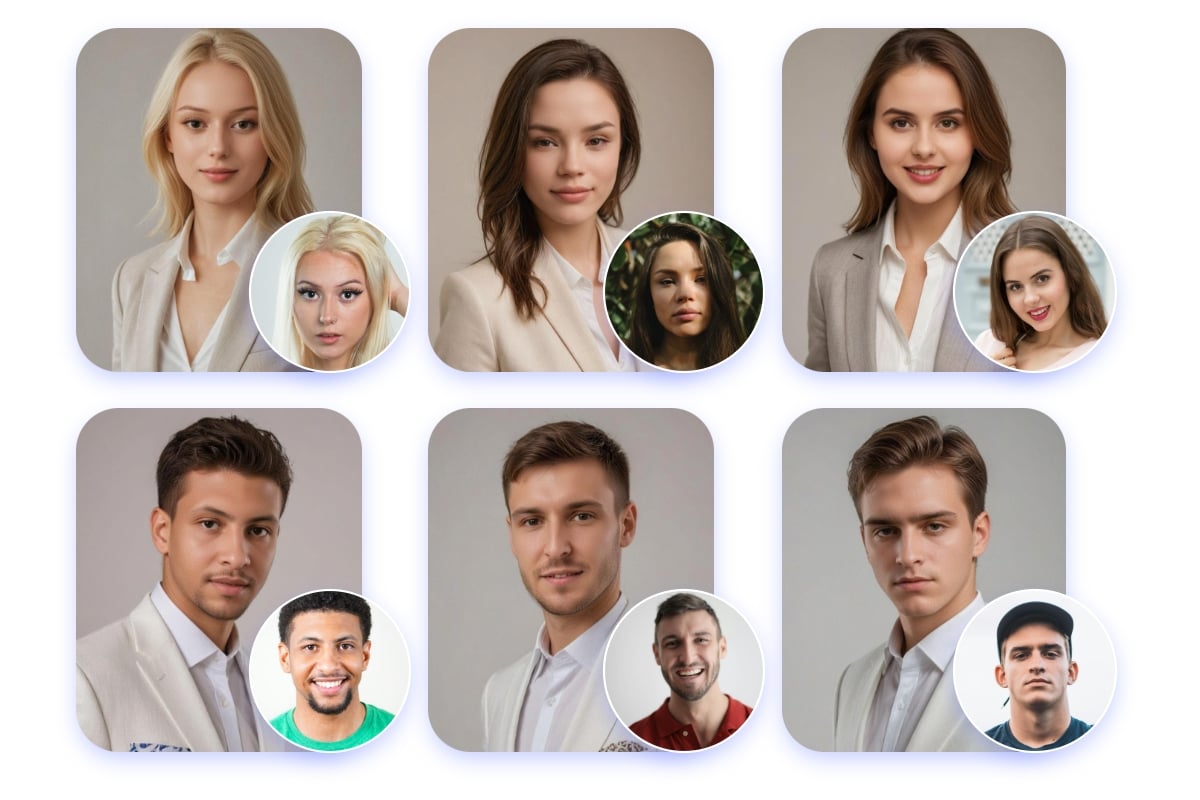
What started as a curiosity in 2023 has become routine infrastructure for personal branding, job hunting, freelancing, consulting, real-estate listings, coaching bios, and even selective dating profiles. The convenience, price point, and accelerating quality have shifted expectations permanently.
How the Experience Feels to Most Users Today
The interaction is deliberately frictionless:
You send 12–30 photos — anything from iPhone selfies in natural light to snapshots taken over coffee or while walking the dog. Between twenty minutes and two hours later (usually closer to the lower end with popular services), a gallery appears containing 60–300 completely new portraits. Most platforms let you filter by style, crop, adjust brightness slightly, remove background, or regenerate specific variants before downloading.
The underlying magic relies on training a lightweight personal identity model from your uploads, then letting a powerful image generator create endless variations while anchoring to that identity.
Main Technological Ingredients in Mid-2026
Current market leaders typically combine:
cutting-edge open-weight diffusion models (Flux.1 [dev] and its community fine-tunes remain the quality benchmark) advanced identity encoders and adapters that lock facial geometry and subtle features far better than 2024 methods multi-pass refinement pipelines — face detail restoration, realistic micro-texture addition, catchlight simulation, hair strand coherence garment and background disentanglement layers so clothing and setting can change independently without leaking artifacts into the face
The most visible improvement since late 2024 is the near-elimination of the uncanny “AI smoothness.” Modern outputs deliberately reintroduce realistic skin grain, faint pores, natural oil sheen, and soft subsurface scattering — exactly the details that scream “photographed” rather than “generated.”
What Makes an AI Portrait Look Credible in 2026
Professional users have internalized a short checklist of deal-breakers:
skin that looks like vinyl or overly filtered Instagram eyes without proper specular highlights or realistic iris texture ears, neck–shoulder junction, or hairline showing clear topology breaks clothing fabric that lacks believable drape, stitching, or material variation mismatched lighting (studio face on outdoor background, for example) random morphing of facial proportions when expression or angle changes
Any service that consistently dodges four or five of these red flags quickly becomes the default recommendation in online communities.
The Styles People Are Choosing Most Often
Download statistics and user galleries reveal clear favorites in early 2026:
Soft modern professional — unstructured blazer, merino sweater, or crisp oxford against warm-toned offices, plants, or light concrete Creative-industry approachable — patterned or colored shirt, interesting brick/textured wall, slightly off-center composition Classic corporate refreshed — navy or charcoal tailoring, clean neutral backdrop, soft Rembrandt-style lighting Relaxed tech / startup energy — quality hoodie + casual layer, natural window or golden-hour feel Dramatic headshot for performers — stronger side lighting, deeper blue-gray or black backgrounds, visible mood
The hyper-polished, cold-blue-gray “LinkedIn CEO 2023” aesthetic has largely faded; warmth, slight imperfection, and approachability now win more clicks and connections.
Areas Where the Technology Still Shows Its Limits
Even the strongest tools have recognizable failure modes:
thin metal eyeglass frames that warp, thicken, or vanish pronounced facial asymmetry or very distinctive bone structure that drifts across generations small accessories (stud earrings, fine chains, tie pins) that randomize or disappear realistic age shifts beyond ±5–7 years (older skin especially tends to look prosthetic) cultural garments, religious headwear, or highly specific professional uniforms anything involving multiple people in frame — identity bleed is almost guaranteed
These constraints mean many people in senior roles, or those needing large-format archival images, still do periodic traditional shoots and use AI for everything in between.
When AI Headshots Clearly Outperform Traditional Sessions
The decision usually tilts toward AI when the situation involves:
urgent profile updates tied to a new role, launch, or rebrand testing ten different visual personalities before committing generating volume — dozens of outfits and backgrounds in one session total spend under $100–150 creative flexibility for actors, speakers, or content creators who want “character” variations
In-person photography keeps the advantage for:
strict corporate identity manuals location-specific shoots (signature office, city skyline, branded environment) maximum large-print fidelity or billboard-quality sharpness the intangible human direction that experienced photographers provide
What’s Coming Next (Late 2026 → 2027)
The roadmap most frequently discussed includes:
live expression & pose sliders during preview (“nudge the confidence up 15%”, “turn head 10° left”) one-minute video uploads as an alternative training input for dramatically better likeness deeper cultural clothing intelligence and support for uploaded personal wardrobe items stronger fine-grained control over gaze, micro-expressions, and subtle emotional valence
AI headshot try it here generation is no longer positioned as a replacement for photography — it is now simply another professional tool with its own strengths, economics, and use cases. For the majority of knowledge workers, creators, and entrepreneurs, the relevant question in 2026 has become not “AI or real?”, but “which AI service currently renders my face most naturally at the resolution and style I need right now?”