Apostille vs Attestation: Key Differences You Should Know

Learn the key differences between apostille and attestation, when each is required, and how Secure Apostille Services Hyderabad helps with fast document legalization.

If you are planning to study, work, start a business, or settle abroad, understanding the difference between apostille and attestation is essential. Many applicants are unsure which document legalization process applies to their destination country, resulting in delays, additional expenses, or rejected applications. At Secure Apostille Services Hyderabad, we help individuals and businesses determine the correct authentication process based on the destination country's requirements, ensuring documents are accepted without unnecessary complications.

Although both apostille and attestation verify the authenticity of official documents, they are used for different groups of countries. Choosing the correct procedure is one of the most important steps before applying for a visa, overseas employment, higher education, family reunification, or international business registration.

What is an Apostille?

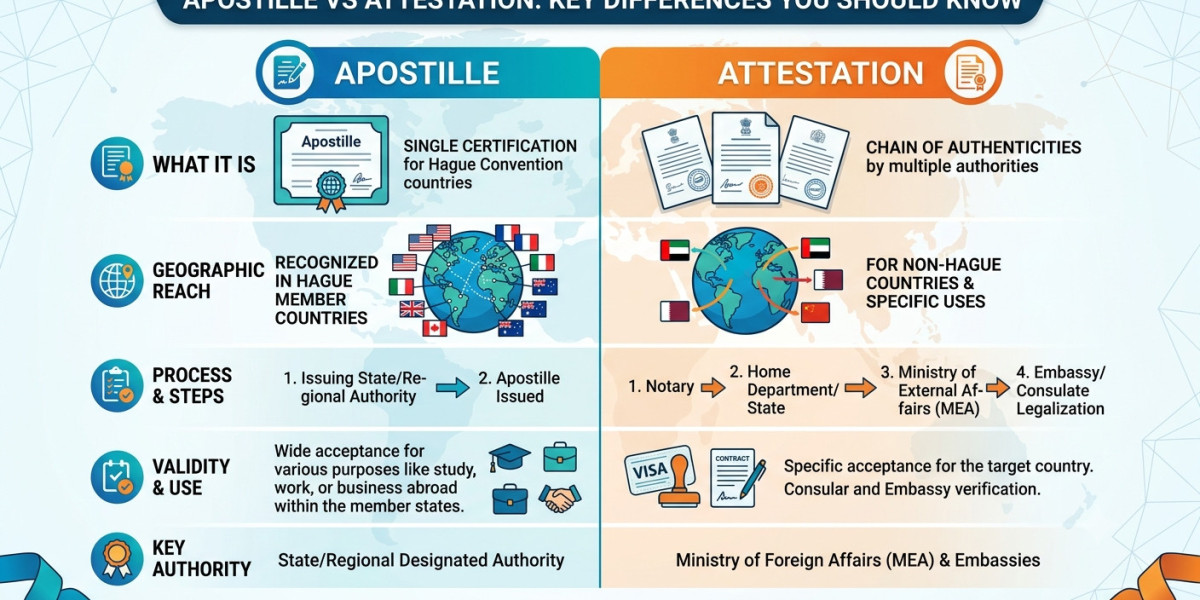
An apostille is an official certification issued by the Ministry of External Affairs (MEA) that confirms the authenticity of a public document. It is accepted only in countries that are members of the Hague Apostille Convention. Once a document receives an apostille, it does not require further legalization from the destination country's embassy or consulate.

The apostille certificate verifies that the signatures, seals, and stamps on the original document are genuine. This simplified process significantly reduces the time required for international document legalization.

Common documents requiring apostille include:

  • Birth Certificates
  • Marriage Certificates
  • Degree Certificates
  • Diploma Certificates
  • Police Clearance Certificates (PCC)
  • Single Status Certificates
  • Commercial Documents
  • Power of Attorney

Individuals travelling for employment, education, immigration, or business frequently require apostille services to ensure their documents are legally recognized overseas.

What is Attestation?

Attestation is a more detailed document authentication process used for countries that are not members of the Hague Convention. Unlike apostille, attestation involves multiple verification stages before the document becomes legally valid abroad.

Depending on the document type and destination country, the process may include:

  • Notary verification
  • State Government Authentication
  • Ministry of External Affairs (MEA) Attestation
  • Embassy or Consulate Attestation

Countries such as the UAE, Qatar, Kuwait, Saudi Arabia, and several other Gulf nations generally require embassy attestation instead of apostille.

Because several authorities are involved, attestation usually takes longer than apostille and requires careful document verification at every stage.

Why People Get Confused

Many applicants mistakenly believe apostille and attestation are the same because both authenticate documents for international use. However, the deciding factor is not the document—it is the destination country.

For example, if you are moving to Germany or France, apostille is generally sufficient. If you are relocating to the UAE or Kuwait, embassy attestation is required instead.

Selecting the wrong legalization method can delay visa approvals and force applicants to repeat the entire documentation process.

Key Differences Between Apostille and Attestation

Although both processes authenticate documents for international use, there are several important differences that applicants should understand before submitting their paperwork.

FeatureApostilleAttestation
Accepted InHague Convention countriesNon-Hague Convention countries
Issued ByMinistry of External Affairs (MEA)Multiple authorities including Embassy
Embassy VerificationNot RequiredMandatory
Processing StepsSingle legalizationMultiple levels of verification
Processing TimeGenerally fasterUsually longer
CostLower due to fewer stepsHigher because of multiple authorities

Understanding these differences helps applicants avoid unnecessary delays and ensures documents are legalized through the correct process.

Countries That Require Apostille

If your destination country is a member of the Hague Apostille Convention, apostille is generally sufficient for document legalization.

Some commonly requested countries include:

  • United States
  • Germany
  • France
  • Italy
  • Spain
  • Netherlands
  • Australia
  • New Zealand
  • Portugal
  • Belgium

Since these countries recognize apostille certificates, embassy legalization is usually not required.

Countries That Require Attestation

Countries outside the Hague Convention require embassy attestation instead of apostille.

Popular destinations include:

  • United Arab Emirates (UAE)
  • Qatar
  • Kuwait
  • Saudi Arabia
  • Bahrain
  • Oman

For these countries, documents typically pass through state authentication, Ministry of External Affairs verification, and finally the respective embassy before becoming legally valid.

Documents That Commonly Require Authentication

Whether you require apostille or attestation depends on your destination country, but the document categories remain largely the same.

Personal Documents

  • Birth Certificate
  • Marriage Certificate
  • Death Certificate
  • Divorce Certificate
  • Single Status Certificate
  • Police Clearance Certificate

Educational Documents

  • Degree Certificate
  • Diploma Certificate
  • Engineering Certificate
  • Nursing Certificate
  • Mark Sheets
  • Transcripts

Commercial Documents

  • Certificate of Incorporation
  • Board Resolution
  • Memorandum of Association
  • Articles of Association
  • Power of Attorney
  • Commercial Invoices
  • Export Documents

Every document category follows a different verification procedure before final legalization.

Which Process Do You Need?

The answer depends entirely on your destination country.

If you are travelling to a Hague Convention member country, apostille is generally the correct option.

If your destination is a country that is not part of the Hague Convention, embassy attestation will be required.

Many applicants waste valuable time by beginning the wrong process. Professional guidance helps identify the correct legalization route from the beginning, reducing delays and preventing document rejection.

Why Choose Secure Apostille Services?

Secure Apostille Services provides complete assistance for document legalization from start to finish. Our experienced team verifies your documents, identifies the correct authentication process, and handles every stage efficiently.

Our services include:

  • Document verification
  • State authentication assistance
  • MEA processing
  • Embassy attestation support
  • Doorstep document pickup
  • Secure document delivery
  • Regular status updates

Whether your documents are required for employment, higher education, immigration, family visas, or international business, our experts help make the process simple, transparent, and hassle-free.




Key Differences Between Apostille and Attestation

Although both processes authenticate documents for international use, there are several important differences that applicants should understand before submitting their paperwork.

FeatureApostilleAttestation
Accepted InHague Convention countriesNon-Hague Convention countries
Issued ByMinistry of External Affairs (MEA)Multiple authorities including Embassy
Embassy VerificationNot RequiredMandatory
Processing StepsSingle legalizationMultiple levels of verification
Processing TimeGenerally fasterUsually longer
CostLower due to fewer stepsHigher because of multiple authorities

Understanding these differences helps applicants avoid unnecessary delays and ensures documents are legalized through the correct process.

Countries That Require Apostille

If your destination country is a member of the Hague Apostille Convention, apostille is generally sufficient for document legalization.

Some commonly requested countries include:

  • United States
  • Germany
  • France
  • Italy
  • Spain
  • Netherlands
  • Australia
  • New Zealand
  • Portugal
  • Belgium

Since these countries recognize apostille certificates, embassy legalization is usually not required.

Countries That Require Attestation

Countries outside the Hague Convention require embassy attestation instead of apostille.

Popular destinations include:

  • United Arab Emirates (UAE)
  • Qatar
  • Kuwait
  • Saudi Arabia
  • Bahrain
  • Oman

For these countries, documents typically pass through state authentication, Ministry of External Affairs verification, and finally the respective embassy before becoming legally valid.

Documents That Commonly Require Authentication

Whether you require apostille or attestation depends on your destination country, but the document categories remain largely the same.

Personal Documents

  • Birth Certificate
  • Marriage Certificate
  • Death Certificate
  • Divorce Certificate
  • Single Status Certificate
  • Police Clearance Certificate

Educational Documents

  • Degree Certificate
  • Diploma Certificate
  • Engineering Certificate
  • Nursing Certificate
  • Mark Sheets
  • Transcripts

Commercial Documents

  • Certificate of Incorporation
  • Board Resolution
  • Memorandum of Association
  • Articles of Association
  • Power of Attorney
  • Commercial Invoices
  • Export Documents

Every document category follows a different verification procedure before final legalization.

Which Process Do You Need?

The answer depends entirely on your destination country.

If you are travelling to a Hague Convention member country, apostille is generally the correct option.

If your destination is a country that is not part of the Hague Convention, embassy attestation will be required.

Many applicants waste valuable time by beginning the wrong process. Professional guidance helps identify the correct legalization route from the beginning, reducing delays and preventing document rejection.

Why Choose Secure Apostille Services?

Secure Apostille Services provides complete assistance for document legalization from start to finish. Our experienced team verifies your documents, identifies the correct authentication process, and handles every stage efficiently.

Our services include:

  • Document verification
  • State authentication assistance
  • MEA processing
  • Embassy attestation support
  • Doorstep document pickup
  • Secure document delivery
  • Regular status updates

Whether your documents are required for employment, higher education, immigration, family visas, or international business, our experts help make the process simple, transparent, and hassle-free.

Hozzászólások