
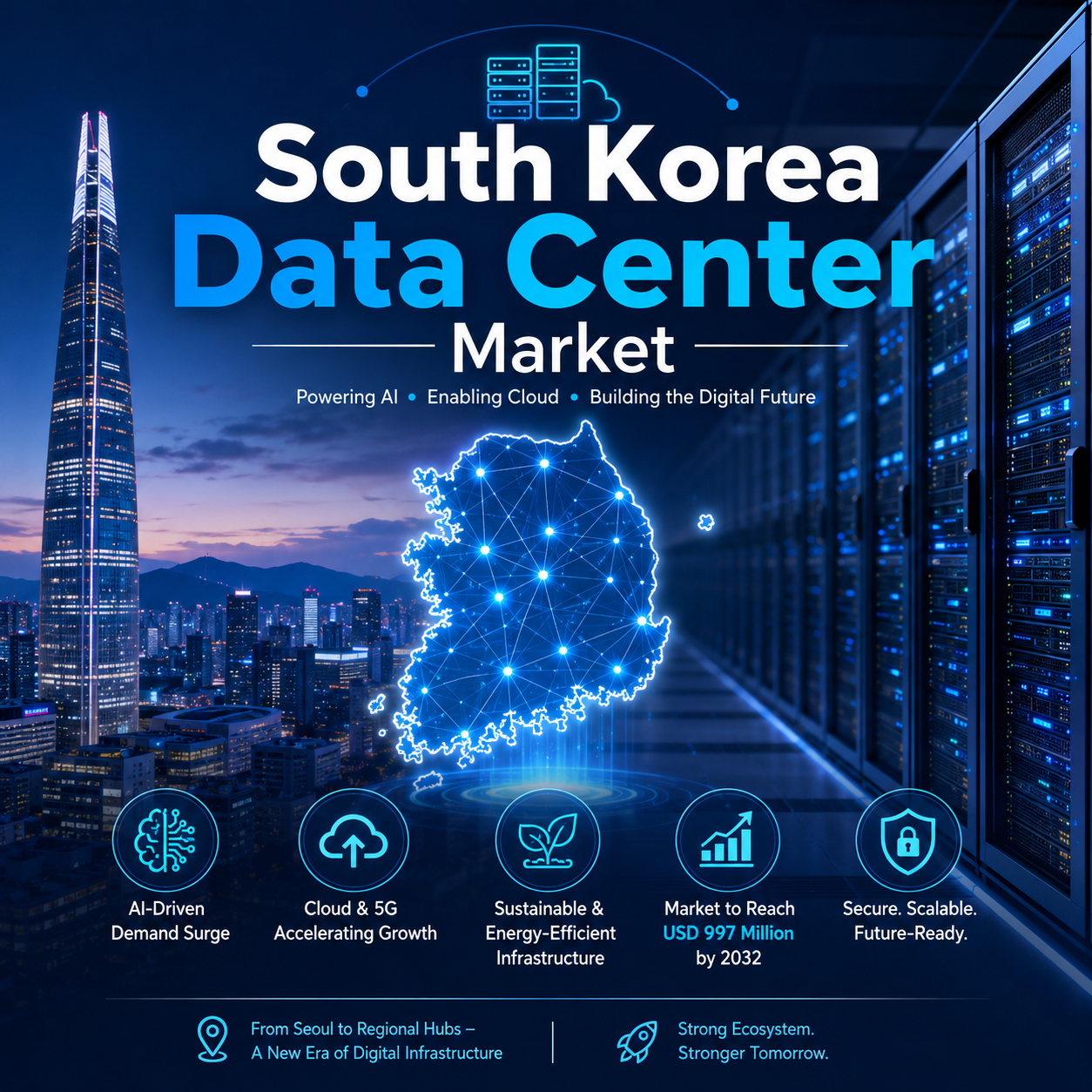
South Korea is rapidly strengthening its position as a technology and digital infrastructure powerhouse, and the South Korea Data Center Market is emerging as a critical pillar of this transformation. Fueled by artificial intelligence (AI), cloud computing, 5G connectivity, IoT, digital services, and rising requirements for secure data storage, the market is entering a period of significant expansion. According to 6Wresearch, the market was valued at approximately USD 598 million in 2025 and is projected to reach USD 997 million by 2032, registering a CAGR of 11.1% during 2026–2032.
AI Is Turning Data Centers into Strategic Infrastructure
Data centers are no longer simply facilities for storing and processing information. The rapid development of generative AI, machine learning, advanced analytics, and high-performance computing is transforming them into strategic infrastructure for South Korea’s digital economy.
AI workloads require substantially greater computing power, high-density server environments, advanced networking, and sophisticated cooling systems. As businesses and technology companies increase their investment in AI applications, demand for scalable and resilient data center infrastructure is expected to accelerate.
South Korea’s strong semiconductor ecosystem further strengthens this opportunity. The presence of major technology companies and advanced chip manufacturers creates an environment where AI hardware, cloud infrastructure, and data center development can evolve together.
Cloud, 5G and IoT Create a Powerful Demand Engine
The continued migration of enterprises toward cloud-based applications is another major growth catalyst. Businesses across financial services, retail, manufacturing, media, and telecommunications increasingly depend on reliable digital infrastructure to manage applications, customer data, transactions, and connected devices.
At the same time, the expansion of 5G and emerging 6G technologies is generating new requirements for low-latency computing. Edge data centers can help process information closer to users and industrial facilities, making them increasingly important for applications such as autonomous systems, smart factories, robotics, gaming, and real-time analytics.
The growth of IoT is adding another layer of demand. As millions of connected devices generate continuous streams of information, companies need infrastructure capable of processing and analyzing data quickly and securely.
From Seoul-Centric Infrastructure to Regional Data Center Clusters
One of the most interesting developments in South Korea is the growing emphasis on regional data center deployment. Traditionally, Seoul and surrounding metropolitan areas have been major destinations for digital infrastructure because of their connectivity, business concentration, and access to customers.
However, high land prices, power constraints, and infrastructure pressure are encouraging operators and policymakers to explore locations beyond the capital region.
Regional industrial hubs can provide opportunities for new facilities while supporting broader economic development. Areas such as Chungcheong and Ulsan are gaining attention as potential locations for data center and technology infrastructure development.
This decentralization could create opportunities for developers, power infrastructure providers, cooling companies, cybersecurity firms, and technology service providers.
Sustainability Becomes a Core Competitive Factor
The expansion of data centers also brings an important challenge: energy consumption. AI-driven facilities can require significant amounts of electricity and advanced cooling infrastructure, putting greater pressure on power networks.
As a result, sustainability is becoming an increasingly important consideration in facility design and operation. Operators are exploring renewable energy integration, energy-efficient power distribution, advanced cooling technologies, and improved Power Usage Effectiveness (PUE).
Liquid and immersion cooling technologies are particularly relevant as high-density GPU infrastructure becomes more common. These solutions can help manage heat more effectively than conventional cooling approaches, supporting the deployment of increasingly powerful computing systems.
Government Support Could Accelerate the Next Wave
Government policy is another important factor shaping the market. South Korea is pursuing large-scale AI and digital infrastructure ambitions, including plans aimed at significantly expanding AI data center capacity.
According to the 6Wresearch market assessment, government-backed initiatives are supporting infrastructure development through investment incentives, regional cluster strategies, and efforts to strengthen domestic AI capabilities.
Such initiatives could create a more favorable environment for data center developers and technology suppliers while helping South Korea strengthen its position in the global AI ecosystem.
Where Are the Biggest Opportunities?
The market presents opportunities across multiple layers of the data center value chain:
- AI-ready infrastructure: Demand for high-density servers, racks, networking, and specialized cooling is increasing.
- Edge computing: Regional and localized facilities can support low-latency applications across industries.
- Green data centers: Energy-efficient systems and renewable energy integration offer long-term growth potential.
- Cybersecurity: Increasing volumes of sensitive data create stronger requirements for physical and digital security.
- Managed services: Automation, monitoring, maintenance, and infrastructure optimization can become increasingly valuable.
- Regional development: New data center clusters outside Seoul could open opportunities for infrastructure and service providers.
6Wresearch identifies IT & Telecom as the leading vertical, accounting for 42.5% of the market in 2025, while the government segment is projected to expand rapidly as sovereign AI infrastructure and public-sector digitalization gain momentum.
Key Players Shaping South Korea’s Digital Infrastructure
The competitive landscape includes major technology, telecommunications, semiconductor, and cloud infrastructure companies. Samsung Electronics, SK Hynix, Naver Corporation, KT Corporation, and LG Uplus are among the prominent players identified in the 6Wresearch assessment. Their capabilities span semiconductors, memory and storage, cloud platforms, telecommunications, networking, and data center services.
Their presence highlights an important characteristic of South Korea’s market: data center growth is closely connected to the country’s wider technology ecosystem.
What Lies Ahead?
The future of South Korea’s data center industry will be shaped by a combination of AI adoption, cloud migration, connectivity expansion, sustainability requirements, and government-backed digital infrastructure development.
The market’s projected rise from USD 598 million in 2025 to USD 997 million by 2032 signals a substantial opportunity for infrastructure developers, technology vendors, investors, telecom operators, cloud providers, and service companies.
However, growth will not come without challenges. Power availability, high operating costs, limited land in major urban areas, skilled workforce shortages, regulatory requirements, and supply-chain pressures could influence the pace and location of new projects.
Ultimately, South Korea’s data center opportunity extends beyond building more facilities. The real opportunity lies in creating smarter, greener, AI-ready infrastructure capable of supporting the next generation of digital services.
Who We Are
About 6Wresearch: 6Wresearch is a commercial strategy and growth advisory firm founded in 2011 and headquartered in New Delhi, India, with partners across Southeast Asia and the Middle East & Africa. The firm has delivered over 20,000 commercial engagements for more than 2,000 organizations, including Fortune 500 companies, government agencies, and multilateral institutions such as the World Bank and the Asian Development Bank.
6Wresearch combines proprietary intelligence, advanced analytics, and sector expertise to help organizations navigate market complexity and drive sustainable growth. These capabilities explain why organizations trust 6Wresearch for reliable commercial insights and confident decision-making.
Our Proprietary Platform: 6W Export GTM
6W Export GTM is 6Wresearch's proprietary trade intelligence and go-to-market platform, built on UN Comtrade data and enhanced with 6Wresearch's in-house analytical and simulation models, including system dynamics-based forecasting.
Unlike broad, sector-level market sizing tools, 6W Export GTM operates at the individual product level down to specific HS codes and micro-segments to identify precise, actionable export opportunities by country and product pair, including markets where trade currently does not exist.
This granular, simulation-driven approach helps surface opportunities that sector-wide analysis can miss, positioning 6W Export GTM among a small number of platforms globally offering this depth of product-and-country-specific export intelligence.