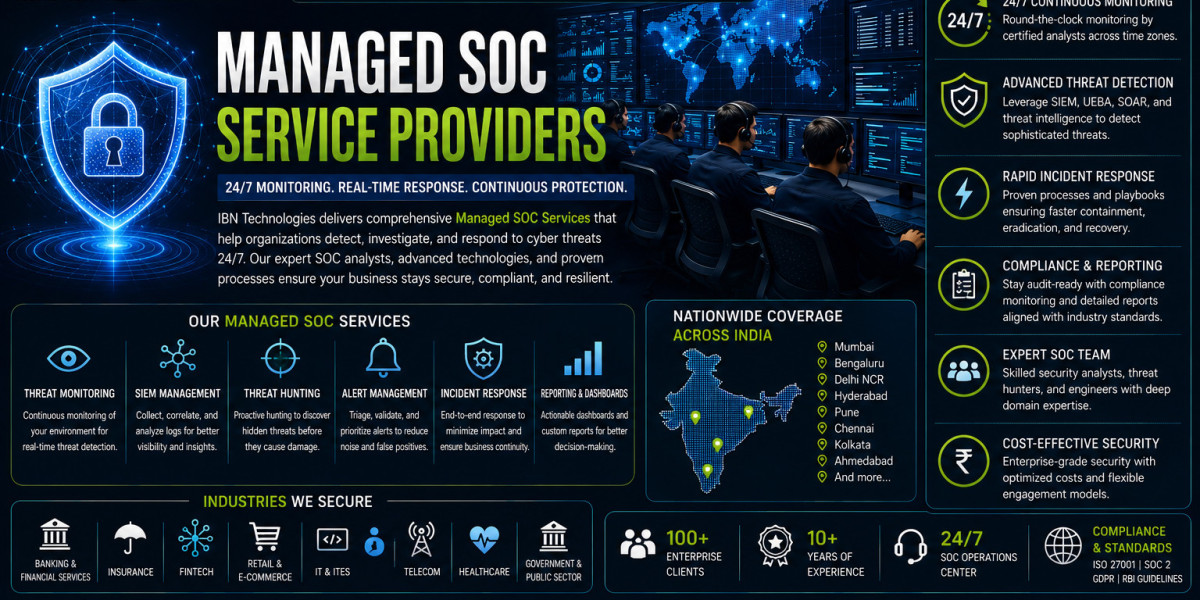

Managed SOC Service Providers and the ICT Outsourcing Decision
For Indian ICT organizations, managed SOC service providers offer outsourced security operations that can complement network, infrastructure, and security teams. The model typically combines security monitoring, SIEM-based event analysis, alert investigation, escalation, and incident response across distributed technology environments.
Why ICT companies are reassessing SOC operations
ICT organizations operate technology environments where availability, connectivity, and security are closely connected. Telecom infrastructure, managed networks, cloud platforms, customer portals, data centers, remote administration tools, and enterprise applications can all generate security events.
Service continuity: Security incidents can affect systems that customers depend on for communication, connectivity, and digital services.
Operational complexity: Network operations teams may monitor availability while security teams need to determine whether unusual activity represents a threat.
Skill requirements: Security investigation requires specialist capabilities that may not be available across every internal shift.
Growth demands: Expanding infrastructure can increase the number of systems requiring security visibility.
For ICT leaders considering managed SOC services in India vs in house SOC for ICT companies, the decision should focus on operating responsibilities rather than simply comparing technology platforms.
In house and managed SOC models
An internal SOC gives an organization direct control over staffing, processes, tools, and security decisions. However, the organization also has to manage recruitment, training, technology administration, monitoring processes, escalation coverage, and operational continuity.
A managed model assigns defined security activities to an external provider. Internal teams can retain governance and organizational decision-making while the provider performs agreed monitoring and security operations.
Direct control: An internal SOC keeps security operations within the organization and can closely align with internal processes.
External capability: A managed SOC can provide additional analyst resources and established security operations processes.
Shared responsibility: A hybrid arrangement can divide monitoring, investigation, governance, and response activities between internal and external teams.
Where traditional ICT monitoring falls short
Network monitoring and security monitoring serve different purposes. A network operations team may identify unusual traffic or service degradation, but determining whether activity represents credential misuse, malware, or unauthorized access requires additional security analysis.
Separate consoles: Analysts may need to examine firewall, endpoint, identity, cloud, and application systems independently.
Limited context: An individual alert may appear harmless until correlated with other events.
Operational workload: Network and infrastructure personnel may already be handling availability incidents, changes, deployments, and customer requests.
Escalation uncertainty: Without documented procedures, teams may not know when an operational anomaly should become a security incident.
SIEM can help bring relevant events into a common security workflow, while managed SOC personnel can support investigation and escalation.
What a managed SOC should provide
The service model should be defined around the ICT organization's technology and operational requirements. A provider should explain what is monitored, how alerts are handled, and which actions require internal approval.
Data integration: Relevant security events are collected from agreed technology sources.
Detection: Security analytics identify activity requiring investigation.
Triage: Analysts assess alerts and determine priority.
Investigation: Related events are reviewed to establish context and potential impact.
Escalation: Significant findings are communicated through agreed channels.
Reporting: Security activity and incidents are summarized for technical and management review.
The objective is not to transfer every security decision to an external party. It is to establish a clear division of responsibilities.
Comparing the operating approaches
Consideration | In house SOC | Managed SOC | Shared model |
Staffing | Fully internal | Provider-led | Shared |
Security monitoring | Internal team | External team | Divided by agreement |
Governance | Internal | Internal | Internal |
Specialist investigation | Internal capability | Provider capability | Shared |
Major incident decisions | Internal | Usually internal | Internal |
Scalability | Requires internal expansion | Service-based expansion | Flexible |
A realistic ICT security workflow
Imagine an ICT provider managing enterprise connectivity and cloud infrastructure. A privileged administrator account generates an unusual authentication event. Shortly afterward, the same account performs unexpected configuration changes.
The first event may appear to be a routine access anomaly. When identity, network, and system activity are correlated, the sequence can provide stronger evidence for investigation.
Authentication review: Security analysts examine the account activity and access context.
Configuration analysis: Changes to critical infrastructure are assessed against expected administrative activity.
Network context: Related connections can help establish whether the activity originated from an expected environment.
Internal validation: The ICT organization can confirm whether the change was authorized.
Incident escalation: If the activity cannot be validated, the agreed response process can be activated.
How to evaluate a provider in India
Indian ICT companies should examine both technical capability and operating discipline. A provider should fit the organization's existing architecture rather than forcing an unsuitable monitoring model.
Technology fit: Check compatibility with existing network, endpoint, cloud, identity, and security platforms.
Coverage: Define which locations, systems, users, and environments receive monitoring.
Response boundaries: Establish exactly what the provider can do without internal authorization.
Reporting: Determine whether reports provide useful information for security, infrastructure, management, and compliance teams.
Integration effort: Understand what the ICT organization must provide during onboarding and ongoing operations.
Service governance: Establish regular processes for reviewing incidents, recurring alerts, coverage changes, and operational issues.
India-specific security considerations
ICT companies operating in India should consider applicable cybersecurity, data protection, contractual, and sector-specific obligations when defining their SOC model.
Regulatory requirements: Relevant CERT-In requirements should be incorporated into applicable incident-management processes.
Customer commitments: Enterprise customers may impose security requirements through contracts and service agreements.
Data handling: Security logs can contain sensitive information about users, devices, systems, and network activity, requiring appropriate controls.
Incident coordination: Responsibilities among security, network operations, infrastructure, customer support, management, and external providers should be documented.
Questions for ICT decision-makers
Is managed SOC services in India vs in house SOC for ICT companies a useful comparison?
Yes, when the comparison examines responsibilities, staffing, technology management, monitoring coverage, investigation, escalation, and governance. Looking only at the security tools used by each model can miss important operational differences.
Can managed SOC service providers work with network operations teams?
Yes. A managed SOC can complement network operations by concentrating on security events while network teams continue managing availability, performance, configuration, and infrastructure operations.
Should an ICT company outsource its entire security operation?
Not necessarily. A company can outsource selected monitoring and investigation functions while keeping security governance, architecture, risk decisions, and major incident authority internally.
Practical selection checks
Map the environment: Identify critical networks, cloud platforms, applications, identities, endpoints, and administrative systems.
Document responsibilities: Write down who monitors, investigates, escalates, approves, contains, and recovers.
Test scenarios: Use realistic examples such as compromised credentials and unauthorized infrastructure changes.
Review integrations: Confirm that important security systems can provide useful data to the monitoring operation.
Measure usefulness: Review whether alerts lead to actionable investigations rather than simply increasing ticket volumes.
Revisit coverage: Update the SOC model when new infrastructure, customers, applications, or cloud environments are introduced.
FAQs
What is the main difference between a managed and in house SOC?
A managed SOC uses an external provider for defined security operations, while an in house SOC is operated directly by the organization. A shared model can combine the two approaches.
Can a managed SOC support telecom and network environments?
Yes, provided the service is designed around the organization's network architecture and relevant security data sources. Network, identity, endpoint, cloud, and application signals can contribute to broader investigations.
Who should make major security decisions in a managed SOC model?
The organization should define this contractually and operationally. Major decisions affecting business systems, customer services, or risk acceptance commonly require clear internal ownership.
IBN Technologies provides managed SOC and SIEM services that can complement internal ICT security and infrastructure operations.
Contact Us
IBN Technologies
Phone: +91 20 6768 0404
Email: sales@ibntech.com