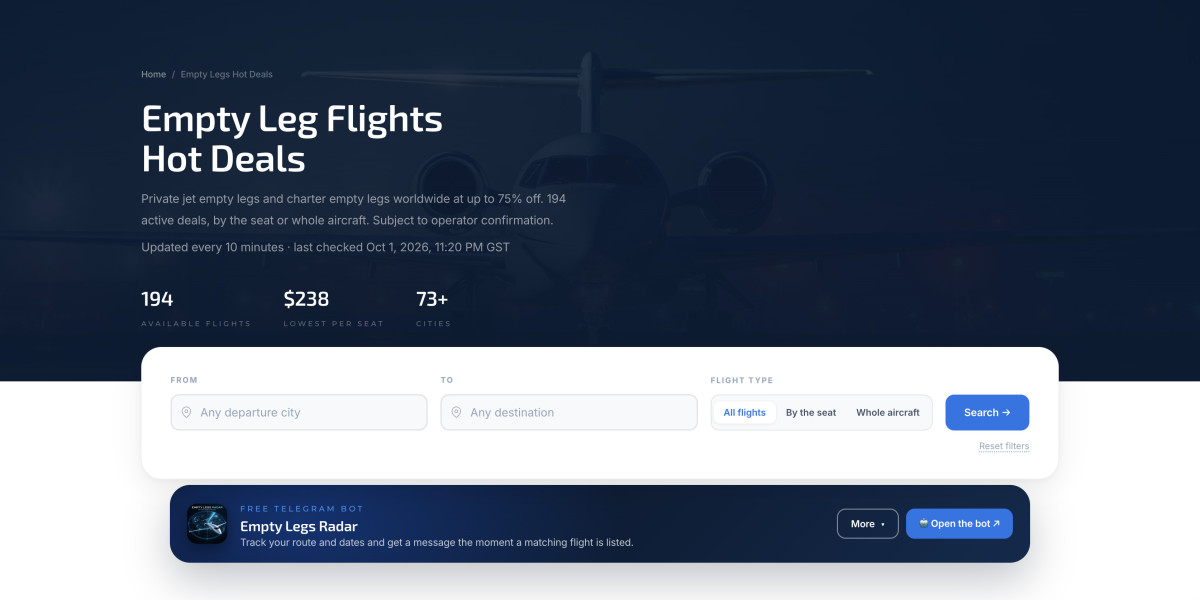

Aircraft can be available to passengers even when no traditional charter has been booked. These opportunities appear when a jet needs to reposition between airports without paying passengers on board. Known as empty legs, these flights may be offered at 50–75% below the price of a normal charter because the aircraft is already scheduled to make the journey.
The discount is straightforward. The operator needs to move the aircraft regardless of whether somebody books the empty sector. Selling seats or the entire aircraft can therefore recover part of the repositioning cost.
The harder problem has traditionally been finding these flights in time.
An empty leg may appear only a few days before departure and can disappear within hours. Availability changes constantly as aircraft schedules change, charter bookings are confirmed and repositioning requirements move from one airport to another.
Dubai-based private aviation company RentJet has approached that problem as a live data challenge. Its Empty Legs Radar combines a web-based marketplace with automated Telegram monitoring designed to make a fragmented and fast-moving category of private aviation easier to follow.
From scattered offers to structured data
Instead of relying on travellers to repeatedly check individual listings, the system collects available empty leg information and refreshes it on a ten-minute cycle.
As of September 28, 2026, the platform typically tracks around 200 active offers at a time, covering more than 140 departure cities and over 420 routes.
The live empty leg flights page includes both offers where individual seats can be purchased and flights available as an entire aircraft. Each listing is structured around the information a traveller actually needs to evaluate an opportunity, including the route, date, local departure time, aircraft type and pricing format.
The website also separates the data into departure-city and route pages. These pages retain recent pricing history, allowing users to see how empty leg availability has developed on a particular city pair rather than viewing each flight as an isolated listing.
The important distinction is that RentJet developed this infrastructure internally. Empty Legs Radar is not a white-label interface for a third-party alert service. The company built the data processing, website presentation and Telegram monitoring around its own workflow while transportation itself continues to be performed by partner operators.
A Telegram bot for routes that matter
The most practical part of the system for frequent travellers is @emptylegsradar_bot.
Users start with the /track command and specify a departure city, destination or an open-ended destination such as anywhere, together with the relevant date range. The bot can monitor up to five routes simultaneously.
Its basic workflow is intentionally narrow:
listings are checked every ten minutes;
one qualifying flight generates one notification;
departure times are shown in the local time of the airport;
no account or registration is required;
the monitoring service is free.
The one-flight, one-notification rule is particularly relevant in a market where the same aircraft movement can otherwise appear repeatedly through changing feeds or updates.
For users who want to follow the broader market rather than specific routes, RentJet also operates the Telegram channel @emptylegsradar, where current opportunities can be viewed without creating individual route alerts.
Why automation changes the search process
Empty legs have never been difficult to understand. Their main limitation has been timing.
A normal charter starts with a customer deciding where and when to travel. An empty leg works in the opposite direction: the aircraft schedule already exists, and the passenger has to find an opportunity that happens to match it.
That difference explains why traditional search behaviour is inefficient. A traveller may check a route in the morning, find nothing and miss a suitable aircraft that becomes available later that afternoon.
With Empty Legs Radar, the traveller does not have to keep repeating the search manually. A route can remain under observation while the underlying feed continues to change.
This is particularly useful for people whose travel dates have some flexibility. A seat on a light jet may begin at a few hundred dollars in some cases, while whole-aircraft empty legs can be substantially cheaper than booking the same sector as a conventional charter. That does not mean a suitable flight will always appear, but it makes the economics worth monitoring.
Building infrastructure around unused capacity
The broader significance of the project is not simply that RentJet has created another page of private jet offers.
Empty leg inventory is temporary by definition. Its value depends on how quickly information can move from an operator schedule to the traveller who can actually use it.
RentJet has therefore built its system around refresh frequency, deduplication, route matching and notification rather than around static listings.
The result is a different way of handling repositioning capacity. Instead of expecting travellers to repeatedly search for aircraft that may or may not appear, the infrastructure continuously watches the market and surfaces a match when the conditions line up.
For an industry in which availability can change several times in a single day, that shift from manual search to automated monitoring may be more important than the marketplace interface itself.