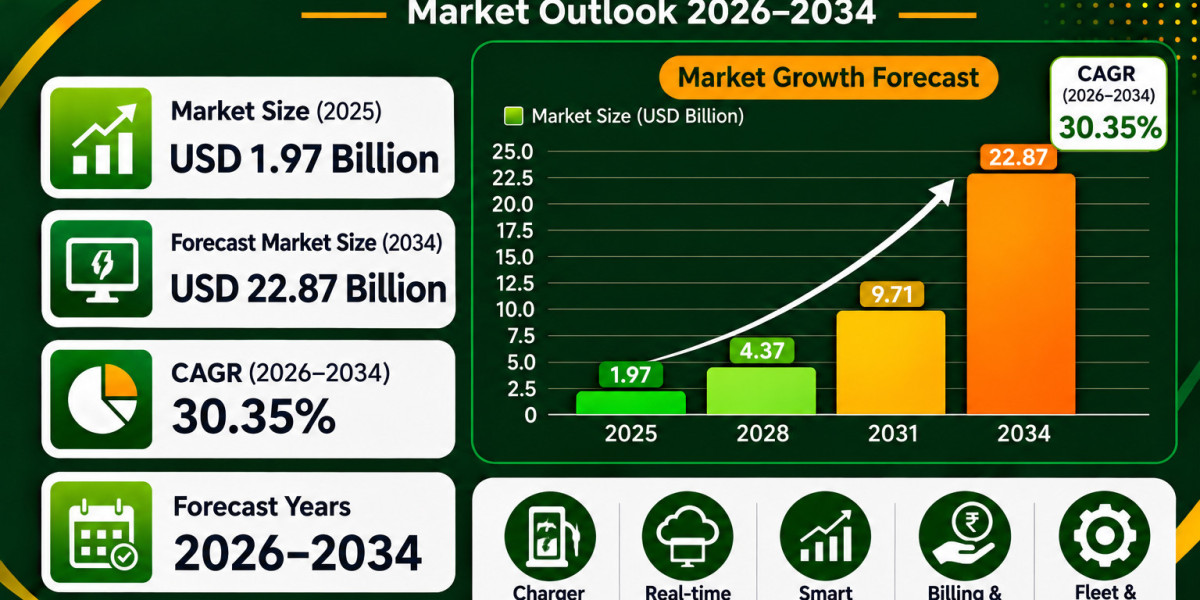

IMARC Group has recently released a new research study titled “EV Charging Management Software Platform Market Size, Share, Trends and Forecast by Module, Deployment, Charger Type, Application, and Region, 2026-2034”, offering a detailed analysis of the market drivers, segmentation, growth opportunities, trends, and competitive landscape to understand the current and future market scenarios.
EV Charging Management Software Platform Market Size & Share 2026-2034
The global EV charging management software platform market size reached USD 1.97 Billion in 2025. The market is projected to reach USD 22.87 Billion by 2034, expanding at a CAGR of 30.35% during 2026-2034. In 2026, the market continues to gain momentum, supported by rising EV adoption, expanding public and private charging infrastructure, and the need for real-time charger monitoring, payment management, and energy optimization. Electric car sales surpassed 20 million units in 2025, a 20% year-on-year increase, with China contributing more than 13 million sales and nearly 60% of global demand.
Growth in 2026 is further reinforced by smart grid integration and fleet electrification, along with the shift of charging management software from basic charger on/off control toward AI-powered energy optimization, vehicle-to-grid (V2G) energy trading, and autonomous demand-response charging. The market is segmented by module (operation management, energy management, EV billing and payment, and others), deployment (private and public chargers), charger type (Level 1, Level 2, and Level 3), application (residential and commercial), and region. These dynamics are expected to strengthen the EV charging management software platform market share throughout the forecast period.
Key Market Statistics at a Glance
- Base Year: 2025
- Historical Years: 2020-2025
- Forecast Period: 2026-2034
- Market Size (2025): USD 1.97 Billion
- Projected Market Size (2034): USD 22.87 Billion
- Growth Rate: CAGR of 30.35% (2026-2034)
Explore Opportunities in the EV Charging Management Software Platform Market: Download the IMARC Sample Report: https://www.imarcgroup.com/ev-charging-management-software-platform-market/requestsample
Key Growth Drivers and Trends in the EV Charging Management Software Platform Market
Growth in the EV charging management software platform market is being driven primarily by rapid global EV adoption. In 2025, electric car sales rose 20% to over 20 million units, and Europe rebounded with sales up more than 30% to 4.2 million units, representing 28% of all new vehicle sales. This growth is increasing the number of charging stations that need centralized monitoring and control, pushing operators to adopt software for charger uptime, payment processing, load balancing, and remote diagnostics.
Smart grid and V2G energy management are also supporting the market. V2G capabilities allow EVs to return power to the grid during peak demand, creating new revenue opportunities for fleet operators and charging networks, while growing renewable energy integration raises demand for software that manages real-time energy flows, pricing, and grid communication. Fleet electrification is a further driver, as operators of buses, trucks, taxis, and delivery vehicles need platforms to manage charging queues, reduce downtime, and optimize energy costs during off-peak hours.
One of the leading EV charging management software platform market growth trends is plug-and-charge authentication. In April 2026, Hubject, Mer, and BMW Group launched Plug&Charge Direct in Germany and Austria, combining secure vehicle recognition and direct credit card payment into one seamless flow. Other emerging trends include roaming and interoperability across charging networks, cybersecurity-enhanced platforms, and mobile app-based charging access and payments. In February 2026, A-1 Sureja Industries introduced the “Yellow EV” mobile app to improve management of its electric two-wheeler operations.
Speak to an Analyst: https://www.imarcgroup.com/request?type=report&id=27712&flag=C
EV Charging Management Software Platform Industry Segmentation Insights
Breakup by Module:
- Operation Management: The leading module, holding a 32.6% share in 2025. It covers charge point monitoring, remote diagnostics, uptime reporting, and firmware management, which operators need to manage sessions, handle faults, and ensure smooth network performance.
- Energy Management: Holds a 27.4% share. Covers load balancing, dynamic scheduling, V2G control, demand-response integration, and renewable energy optimization.
- EV Billing and Payment: Holds a 21.8% share and is the fastest-growing module at about 32.4% CAGR. Covers session billing, plug and charge, roaming settlement, dynamic pricing, and subscription management.
- Others: Holds an 18.2% share. Includes analytics and reporting, driver mobile apps, and fleet telematics integration.
Breakup by Deployment:
- Public Chargers: The leading deployment, holding a 72.6% share in 2025. Public chargers require centralized software for real-time monitoring, user access, payments, load management, and maintenance tracking, supported by government-mandated deployment across highways, urban centers, and retail locations.
- Private Chargers: Holds a 27.4% share and grows fastest at about 31.2% CAGR, driven by fleet depot electrification, workplace charging, and multi-family residential charging management.
Breakup by Charger Type:
- Level 1: Entry-level charging with basic management requirements.
- Level 2: The leading charger type, holding a 53.2% share in 2025.
- Level 3: Fast and ultra-fast charging, which increases the need for advanced power management, real-time monitoring, and intelligent load balancing.
Breakup by Application:
- Residential: Home and multi-family residential charging management.
- Commercial: The leading application, holding an 82.6% share in 2025, covering public networks, workplaces, retail sites, and fleet depots.
Breakup by Region:
- North America: The largest region with a 30.0% share in 2025, driven by strong EV adoption, extensive public charging network expansion, fleet electrification, and investments in smart charging and grid integration.
- Asia Pacific: Holds a 29.4% share, benefiting from rapid EV deployment, large-scale charging infrastructure development, supportive government policies, and growing demand for cloud-based solutions.
- Europe: Holds a 24.6% share, driven by stringent emission regulations, widespread EV adoption, cross-border charging interoperability initiatives, and investment in smart charging.
- Latin America: Holds an 8.2% share, supported by urban electrification programs, public charging investments, and sustainable mobility initiatives.
- Middle East: Holds a 4.1% share, supported by smart city projects, government-led sustainability programs, and EV infrastructure investments.
- Africa: Holds a 3.7% share, gradually expanding through EV mobility initiatives, pilot charging projects, and renewable energy integration.
Key Challenges and Growth Opportunities in the EV Charging Management Software Platform Market
The market faces restraints from high platform implementation costs, including software licenses, hardware integration, cloud infrastructure, cybersecurity, and maintenance, which can delay adoption among small charging networks and in emerging markets. Cybersecurity vulnerability of grid-connected charging point management systems (CPMS) is another concern, as platforms link payment systems, user data, chargers, and grid networks. Grid capacity constraints and peak-load management, along with data privacy and user authentication concerns, add further challenges.
The market offers considerable growth opportunities, including AI-powered autonomous charging optimization and Mobility-as-a-Service (MaaS) integration with ride-hailing, car-sharing, and public transport systems. In May 2025, Noodoe introduced an AI-powered charging management system whose AI Advisor uses generative AI to optimize charging station pricing, improve revenue, and increase station utilization. Other opportunities include V2G energy trading platforms, fleet depot solutions for logistics, and interoperability hubs for multi-network roaming. The fastest-growing segments through 2034 include EV billing and payment (about 32.4% CAGR), energy management and V2G (about 31.8% CAGR), and private and fleet CPMS (about 31.2% CAGR).
Competitive Landscape
The IMARC report provides a comprehensive analysis of the competitive landscape of the EV charging management software platform market, which is moderately concentrated and spans vertically integrated hardware-software companies, pure-play software vendors, and energy company platforms. The landscape is being reshaped by white-label platform commoditization, AI differentiation, and energy company market entry. Key companies covered include ChargePoint, Inc. (market leader), Siemens (market leader), Schneider Electric and Blink Charging Co. (strong challengers), and Monta (niche player). Detailed profiles of all major companies are also included.
Recent Developments in the EV Charging Management Software Platform Market
- April 2026: Hubject, Mer, and BMW Group launched Plug&Charge Direct in Germany and Austria, enabling automated EV charging authentication with direct credit card payment.
- March 2026: SK Signet introduced its new 400kW all-in-one ultra-fast EV charger, using high-density silicon carbide (SiC) power modules and a high-efficiency design to improve energy efficiency and space utilization.
- February 2026: A-1 Sureja Industries introduced the “Yellow EV” mobile app to improve management of its electric two-wheeler operations, supporting onboarding, service coordination, workflow management, and customer engagement.
- November 2025: ChargePoint introduced a next-generation ChargePoint Platform, a flexible software solution built from the ground up to help operators optimize charging infrastructure across single sites or global networks.
- May 2025: Noodoe introduced an AI-powered charging management system, highlighted in an AWS case study, whose AI Advisor uses generative AI to optimize charging station pricing and improve utilization.
Author IMARC Group
IMARC Group is a leading global market research company providing data-driven insights and expert consulting services to businesses seeking to achieve their strategic objectives. With a multidisciplinary team of industry experts, IMARC delivers reliable market intelligence across sectors including Chemicals and Materials, Healthcare, Technology, Agriculture, and Retail.
Contact Us:
IMARC Group
Email: sales@imarcgroup.com
United States: +1-201-971-6302